STEPHANIE WEST CONSULTANT OPHTHALMIC SURGEON

CHILDREN’S EYE CARE

Glasses for Children

Being told that your child needs glasses can raise lots of questions—especially if they seem to manage perfectly well without them.

Children’s glasses are prescribed to give clearer, more comfortable vision and, importantly, to support normal visual development. They may also help a squint, reduce the risk of amblyopia (a “lazy eye”) or make it easier for your child to learn and play.

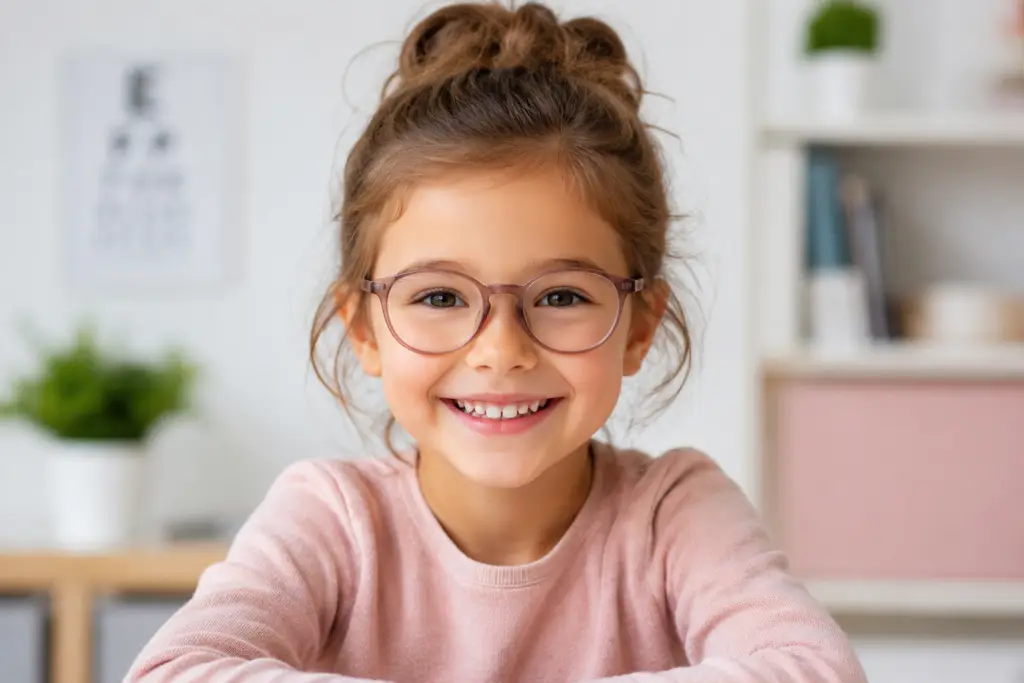
Smiling young girl wearing glasses for vision correction

Why might my child need glasses?

The reason is not always simply “they cannot see”. We prescribe glasses when the expected benefit is greater than leaving the eyes to compensate.

Clearer vision

Glasses bring the image into focus so your child can see detail more easily at distance, near or both.

Healthy visual development

A clear image in each eye helps the brain learn to use both eyes during the important early years.

Better eye alignment

In some children—especially those who are long-sighted—glasses reduce the focusing effort that can make an eye turn in.

Glasses can be part of amblyopia treatment. If one eye receives a blurrier image than the other, the brain may favour the clearer eye. Correcting the prescription gives the weaker eye the best possible image and may be combined with patching or atropine treatment when needed.

Why can my child still see without them?

This is one of the most common questions parents ask. A child may appear to see well without glasses for several reasons:

  • Children are excellent at compensating. A long-sighted child can use their strong focusing muscles to clear the image, although this may cause effort, headaches, tiredness or an inward squint.
  • One eye may be doing most of the work. With different prescriptions in the two eyes, the stronger eye can mask poor vision in the other.
  • Everyday tasks are forgiving. Large objects, familiar faces and close-up toys may still be visible even when fine detail is blurred.
  • Blur can feel normal. A child who has never experienced a sharper image may not know that their vision is different.

Being able to navigate a room or recognise a parent does not tell us how clearly each eye sees or how hard the child is working to focus.

A useful way to think about it

Glasses are not prescribed only because a child fails to cope. They are prescribed to give the eyes and brain the best-quality image during development—before a problem becomes obvious.

Types of Glasses Prescription in Children

These animated diagrams show where light focuses in the eye and how glasses help correct each type of prescription.

retina focus behind
HYPERMETROPIA

Long-sightedness

Without enough focusing effort, light would come to a focus behind the retina. Children can often compensate by focusing strongly, which is why they may still appear to see well.

What the glasses do: Plus-powered lenses bring the focus forward and reduce the effort needed to see clearly.
retina focus before
MYOPIA

Short-sightedness

Light focuses before it reaches the retina. This makes distance detail blurred, although close objects may remain clear.

What the glasses do: Minus-powered lenses move the focus backwards onto the retina.
retina two focal positions
ASTIGMATISM

Uneven focus

The eye has different focusing power in different directions, so light does not form one sharp focus. This may blur or distort vision at both distance and near.

What the glasses do: Cylinder power and axis correct the uneven focus in the appropriate direction.
Eye 1 Eye 2 clearer image blurrier image
ANISOMETROPIA

Different prescription in each eye

One eye may be more long-sighted, short-sighted or astigmatic than the other. The clearer eye can mask reduced vision in the eye with the larger prescription.

What the glasses do: Each lens has the power needed for that eye, helping the brain receive a clearer and more balanced pair of images.
These are simplified teaching diagrams. A child may have more than one type of refractive error, and the final prescription is based on the full examination, including cycloplegic refraction when appropriate.

Astigmatism: a little more detail

Astigmatism is sometimes described as the eye being shaped more like a rugby ball than a football. This is only an analogy—the eye can look completely normal from the outside.

It is not caused by reading, screens or wearing glasses. A child with astigmatism may screw up their eyes, sit closer, confuse fine detail or have no obvious symptoms at all. The first pair of glasses can make the world look unusually sharp or slightly stretched for a few days; regular wear usually helps the brain adapt.

Important: An astigmatism prescription includes a cylinder and an axis. The axis is an angle, not a measure of severity, and it can change slightly between examinations without meaning that anything is wrong.

How do we measure glasses in children?

Measuring a child’s prescription is different from testing an adult because children can use their focusing muscles to temporarily overcome blur. The method we use depends on their age, cooperation and the reason for the glasses.

YOUNGER CHILDREN

Cycloplegic refraction

Children can focus very strongly, sometimes hiding part of a long-sighted prescription. Cycloplegic eye drops temporarily relax the focusing muscles so we can measure the underlying prescription accurately.

  • Drops are placed in each eye and allowed time to work.
  • We then use retinoscopy and, where appropriate, an autorefractor.
  • Your child does not need to read letters or decide which lens looks clearer.
  • Near vision may be blurred and the pupils may remain enlarged for several hours.
OLDER OR COOPERATIVE CHILDREN
“Which is clearer — one or two?”

Subjective refraction

As children become older and can reliably compare lenses, the prescription can be refined by asking which choice gives the clearest and most comfortable vision.

  • Different lenses are placed in front of the eyes.
  • The child compares options such as “one or two”.
  • This helps fine-tune clarity and comfort.
  • It is similar to the refraction commonly performed at a community optician.
Cycloplegic refractionMeasures the prescription after temporarily removing the child’s ability to over-focus.
Subjective refractionUses the child’s answers to refine which lenses look best.
Sometimes we use both. An older child may still need cycloplegic drops if we suspect hidden long-sightedness, a focusing problem, a squint or an unreliable subjective result. The final glasses prescription is based on the whole examination—not simply the machine reading or the strongest number measured after drops.

How often should the glasses be worn?

Full-time wear

Often recommended when the prescription is needed throughout the day, when one eye is weaker, or when glasses help control a squint.

Distance or classroom wear

Sometimes suitable for mild myopia or a specific distance task. Follow the individual instructions given for your child.

Build a routine

Put glasses on after getting dressed, keep the case in the same place and ask school or nursery to support the plan.

Please follow the wear instructions given at your child’s appointment. The same prescription can be used for different reasons, so advice that is right for another child may not be right for yours.

Choosing glasses your child will want to wear

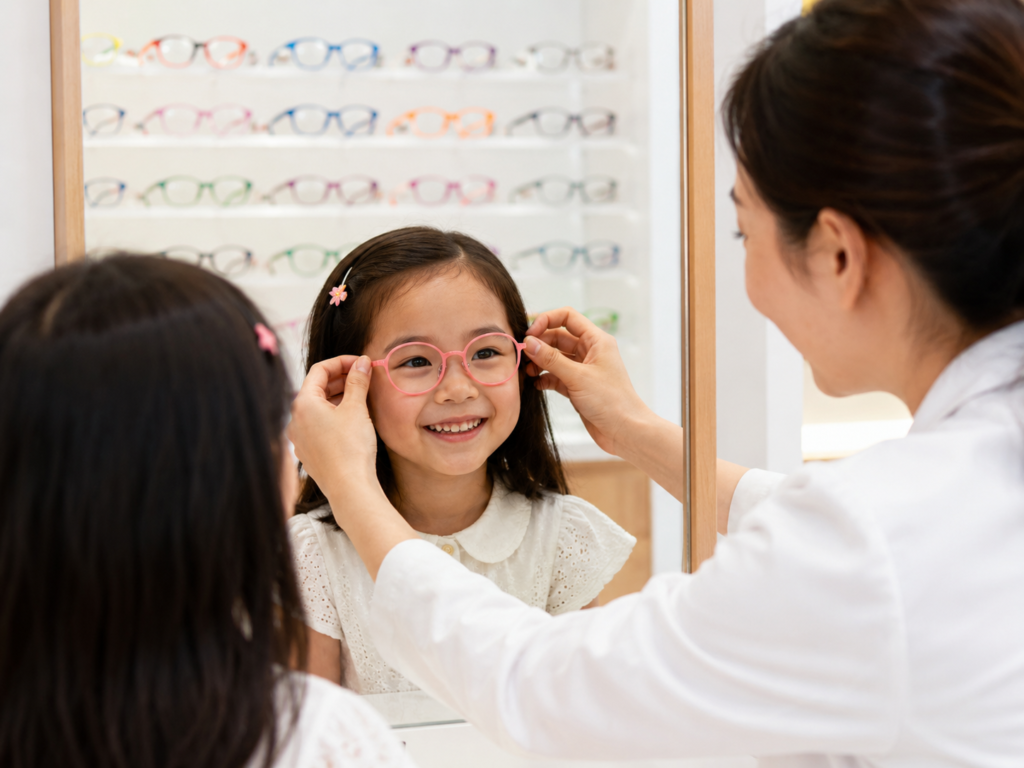
The best children’s glasses are the pair that fits well, gives a clear view through the centre of the lenses and feels comfortable enough to stay on.

Fit before fashionThe bridge should sit securely, the lenses should be centred in front of the eyes and the frame should not slide down.
Comfort mattersLook for light frames, suitable side length and no pressure behind the ears or on the nose.
Let your child chooseOffer two or three well-fitting options and let your child pick their favourite colour or style.
Choose durable lensesAsk the dispensing optician about impact-resistant lenses, scratch-resistant coatings and sports-safe frames.
Use positive languageTalk about what the glasses help your child do—read, recognise faces, play and learn—rather than presenting them as a problem.
Return if they slipChildren grow quickly. Small adjustments can make a large difference to comfort and how well the glasses work.

Swimming, sport and spare pairs

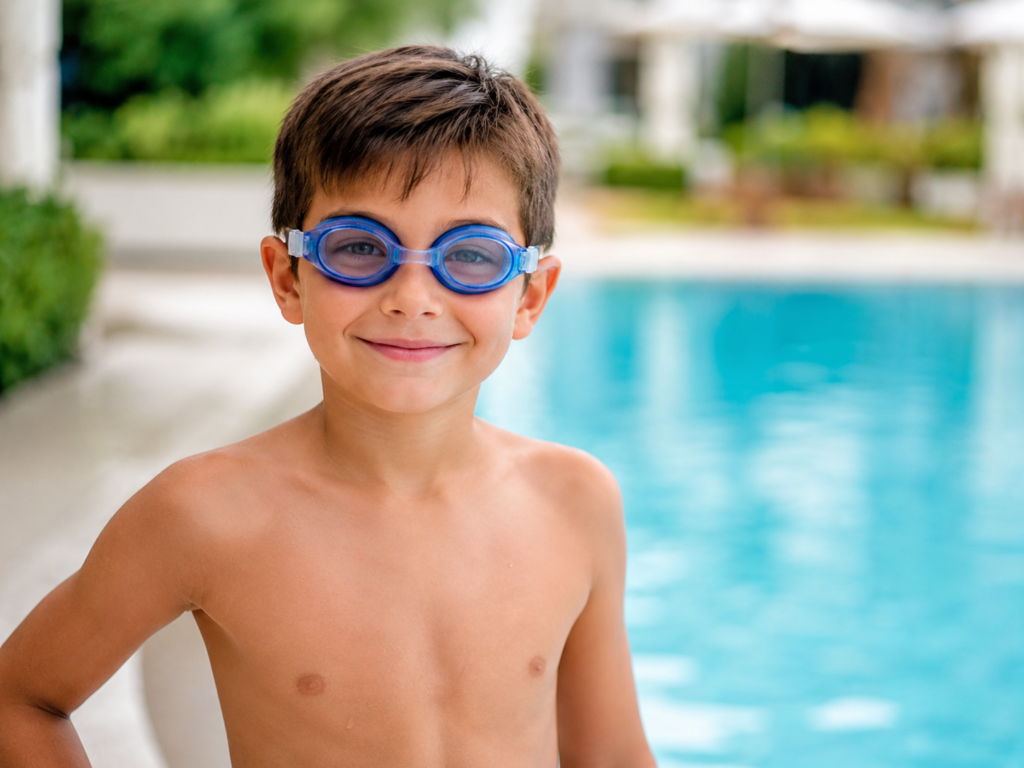
Prescription swimming goggles are available. Some use ready-made lens powers and others can be made more precisely. They are particularly helpful for children with stronger prescriptions who otherwise struggle to see poolside instructions, lane markings or family members.

For contact sports, ask about prescription sports goggles or protective eyewear that meets the relevant safety standard. Ordinary frames are not designed for every sport.

A spare pair is sensible when glasses are needed full time. Prescription sunglasses can also be useful, particularly for children who are light-sensitive or using atropine drops. These extra pairs are usually purchased privately.

Pool safety: Clearer vision is helpful, but swimming goggles do not replace adult supervision or normal water-safety precautions.

How will the prescription change as my child grows?

Children’s eyes grow and their focusing system develops, so prescriptions are not expected to remain identical forever. The pattern varies between children and cannot be predicted perfectly from a single examination.

Accurate measurement
Eye drops may be used to relax the focusing muscles so that the underlying prescription can be measured reliably.
Growing eyes
As the eye grows, long-sightedness may reduce, while short-sightedness often increases during the school years.
Regular review
Astigmatism and differences between the eyes can also change, so the prescription and vision should be checked at the interval advised.
Update only when needed
A new prescription is given when the change is clinically meaningful—not simply because a set amount of time has passed.
Do not stop the glasses simply because the prescription may change. The current pair is prescribed for what your child’s eyes need now. We will reduce, increase or stop the prescription when the examination shows that it is appropriate.

NHS optical vouchers and private appointments

In England, children under 16—and young people aged 16, 17 or 18 in qualifying full-time education—are generally eligible for a free NHS sight test and help towards the cost of glasses or contact lenses.

Why we cannot issue an NHS optical voucher

Children are usually entitled to help with the cost of glasses through the NHS. However, an NHS GOS3 optical voucher must be issued through an NHS General Ophthalmic Services sight test or an eligible NHS hospital eye service. A private consultation with Stephanie West is not an NHS GOS sight test, and our private clinic is not commissioned to issue or process GOS3 vouchers.

We can provide your child’s written prescription and clinical findings. You can take these to your chosen dispensing optician. To use an NHS voucher, the optician may need to carry out or arrange the appropriate NHS sight-test process and confirm eligibility. The voucher is a contribution based on the prescription and may not cover the full cost of every frame or lens option.

Practical next step: Before ordering glasses, tell your chosen optician that the prescription came from a private ophthalmology appointment and ask how they handle NHS eligibility and vouchers. This avoids unexpected costs.

Common questions from parents

Will wearing glasses make my child’s eyes weaker?No. Glasses do not make the eyes lazy or dependent. They provide the focus your child needs while the visual system is developing.
Why does my child keep looking over the top?The frame may be slipping, the prescription may feel unfamiliar or your child may need time to adapt. Check the fit first and contact us or your optician if the problem continues.
How long does it take to adjust?Many children adapt within a few days, although stronger prescriptions or astigmatism can take longer. Consistent wear usually makes adaptation easier.
Do we need a spare pair?A spare pair can be very useful, especially for full-time wear, but NHS vouchers do not routinely fund an additional pair. Ask your optician about economical spare options.
Still unsure about your child’s glasses?

We can explain the prescription, whether it should be worn full time, how it relates to a squint or amblyopia, and when your child should be reviewed.

Recognised by major insurers
bupa AXA Health Vitality WPA Cigna Aviva
Benenden Health
Healix
Simplyhealth
The Exeter
Vanbreda

Please contact your insurer before booking to confirm your cover and obtain any required authorisation.