STEPHANIE WEST CONSULTANT OPHTHALMIC SURGEON
Specialist squint, double vision and children’s eye care in Southampton
Squint Surgery for Children
Specialist paediatric squint surgery in a calm, family-centred environment, with experienced children’s nurses and a paediatric anaesthetic team.
Stephanie will explain whether surgery is likely to help, what the operation can achieve and how your child will be supported before, during and after their hospital visit.

What happens during children's squint surgery?
Add your forthcoming video here to explain the hospital day, anaesthetic, operation and recovery in a reassuring way.
Paediatric squint expertise
Assessment and surgery planned around your child's particular squint, vision and binocular function.
Own private room
Your child has a private, child-friendly en-suite room where the family can settle before and after surgery.
Children's nursing care
Registered children's nurses provide dedicated support on the ward.
Paediatric anaesthetic team
An anaesthetist experienced in caring for children explains and manages the general anaesthetic.
When might squint surgery help?
Surgery may be recommended when an eye misalignment remains despite appropriate glasses, observation or other treatment. The purpose may be to improve eye alignment, binocular function, an unusual head posture, troublesome double vision or the appearance of the eyes.
Not every squint needs surgery. Some are best managed with glasses, patching, prisms, observation or treatment of the underlying cause.
What surgery cannot promise
Squint surgery does not usually remove the need for glasses, and it does not directly treat amblyopia. Patching or atropine may still be required if vision remains unequal.
Although most children obtain a worthwhile improvement, perfect alignment cannot be guaranteed and some children need further surgery later in childhood or adulthood.
Planning the operation
Glasses and vision checked → repeated orthoptic measurements → goals discussed → operation planned → pre-assessment
Measurements are often repeated because a child’s squint can vary. The muscles and amount of surgery are tailored to those findings.
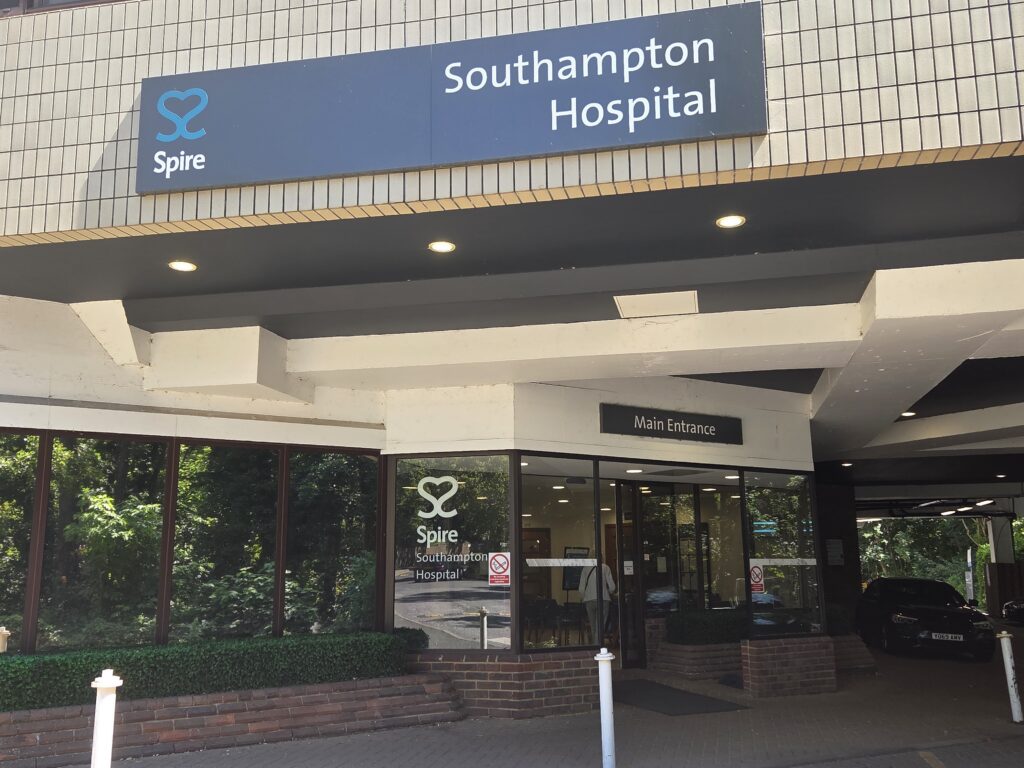
Why surgery is performed at Spire Southampton Hospital
Spire Southampton is one of the relatively small number of independent hospitals with facilities and staffing for planned paediatric surgery. Children are cared for in a private, child-friendly room by registered children’s nurses, with consultant surgical and anaesthetic care.
The hospital’s paediatric surgical service is for children aged three years and over. If squint surgery is unusually required before a child’s third birthday, Stephanie will explain the most appropriate alternative options, which may include care at a specialist NHS paediatric centre.
A reassuring environment
Your child’s room provides a private base for the day. Bring a favourite toy, comforter, book or tablet. A parent or carer can remain with the child while they are on the ward.
The children’s nursing team checks observations, applies numbing cream if required and helps prepare the child for theatre.
What happens on the day?
Arrive and settle in
Your child is welcomed to the ward and shown to their own private, child-friendly en-suite room.
Meet the team
A children's nurse, Stephanie and the paediatric anaesthetist talk you through the day.
General anaesthetic
Your child is asleep and pain-free during surgery. A parent can usually accompany them to the anaesthetic area.
Recovery and home
You are reunited after surgery. Most children drink, eat a light snack and go home later the same day.
Your child's general anaesthetic
Squint surgery in children is normally performed under a general anaesthetic, so your child is unconscious and pain-free throughout the operation.
The paediatric anaesthetist reviews your child’s health, explains how the anaesthetic will be given and discusses common side effects and relevant risks. The anaesthetic may begin through a small cannula or, in some children, by breathing anaesthetic gas through a mask.
A parent can usually accompany the child while the anaesthetic starts. The exact arrangements are confirmed by the hospital team on the day.
Preparing your child
- Follow the hospital’s fasting instructions exactly
- Tell the team about recent coughs, colds, fever or illness
- Bring regular medicines and details of allergies
- Use simple, honest explanations appropriate for your child’s age
- Bring a favourite comfort item
- Write down any questions for the surgeon or anaesthetist
Anaesthetic information for children and families
The Royal College of Anaesthetists provides age-appropriate leaflets, stories and videos for younger children, older children, teenagers and parents. The QR-code sheet brings these resources together in one place.
Resources include Your child’s general anaesthetic, Rees Bear has an anaesthetic, Dennis has an anaesthetic, risk information, videos and guidance about supporting a child through surgery.

What does the operation involve?
The eye is not removed. Stephanie reaches the eye muscles through a small opening in the clear surface tissue and adjusts one or more muscles to change the eye’s resting position.
Small opening
The eye itself is not removed. A small opening is made in the thin surface tissue over the eye muscle.
Muscle position adjusted
One or more eye muscles are weakened, strengthened or repositioned according to the measurements.
Dissolvable stitches
Tiny stitches close the surface tissue and usually dissolve by themselves.
Immediately after surgery
Your child wakes in the recovery area with specialist staff nearby. You will be reunited as soon as it is safe.
The eyes may be red, watery or sticky, and can feel gritty or sore. Children receive pain relief and anti-sickness treatment as needed. Once your child is awake, comfortable and able to drink, they return to their room.
Most children go home later the same day, although the team will keep them for as long as clinically necessary.
At home
- Use eye drops or ointment exactly as prescribed
- Give simple pain relief as advised
- Expect redness for several weeks
- Avoid rubbing the eyes
- Follow the instructions about school, sport and swimming
- Contact the team for increasing pain, worsening swelling, reduced vision, fever or significant discharge
First few days
The eyes can be red, watery, gritty and mildly sore. Double vision can occur temporarily.
Return to school
Many children return after about one week, depending on comfort and the advice given.
Sport and swimming
Avoid swimming and strenuous or contact sport until Stephanie confirms it is safe.
Follow-up
Alignment, healing, vision and any continuing glasses or amblyopia treatment are reviewed.
Questions your child may ask
Will I be asleep?
Yes. The anaesthetist gives you medicine so you are completely asleep during the operation.
Can Mum or Dad stay?
A parent can stay with you on the ward and can usually come with you while the anaesthetic starts.
Will it hurt?
Your eye may feel sore or gritty afterwards, but the team gives medicine to keep you comfortable.
Can I bring my teddy?
Yes. A favourite toy, book or comforter can make the day feel more familiar.
Download your patient information
Important
The information on this page is general. Your child’s operation, recovery and risks depend on their age, health and type of squint. The individual plan discussed with Stephanie, the anaesthetist and the hospital team takes priority.
Frequently asked questions
Yes. Children’s squint surgery is normally performed under a general anaesthetic.
A parent or carer can stay with the child on the ward and can usually accompany them while the anaesthetic begins, subject to the anaesthetic team’s arrangements.
No. The eye remains in its normal position. The muscles are reached through a small opening in the surface tissue.
Sometimes one eye is operated on and sometimes both. This depends on the squint measurements and the surgical plan.
The duration varies with the number of muscles being operated on. Stephanie will explain the expected timing for your child’s procedure.
Most children have day-case surgery and go home later the same day once they are comfortable, drinking and medically ready.
Most children have mild to moderate soreness, grittiness or stinging that is controlled with simple pain relief.
Redness can remain noticeable for several weeks and gradually fades.
Temporary double vision can occur as the brain adapts to the new alignment. Persistent or troublesome double vision should be reported.
Surgery aligns the eyes but does not directly treat amblyopia. Glasses, patching or atropine may still be needed.
Often yes. Squint surgery changes eye alignment but does not usually remove the glasses prescription.
Yes. Alignment can change as a child grows, and some children require further treatment or another operation.
Many children return after approximately one week, depending on comfort and the instructions given.
Spire Southampton’s paediatric surgical service is for children aged three and over. If earlier surgery is required, Stephanie will advise on suitable alternative pathways.
Contact the hospital before attending. The anaesthetist may recommend postponing surgery for safety.
Specialist squint care — easier to reach than you may think
Patients travel to Southampton from across the UK and overseas for specialist assessment and treatment of adult squint, double vision, complex eye movement problems and previous squint surgery. A video consultation can often be arranged first, helping us review your history and plan the most useful next steps before you travel.
Start with a video consultation
Your first appointment may be held by secure video. This is particularly helpful for patients travelling a long distance or coming from overseas.
Before the consultation, you can share previous clinic letters, orthoptic measurements, glasses or prism prescriptions, scan reports and earlier squint surgery records. This helps us understand your condition and decide what assessment or treatment may be appropriate.
Straightforward UK travel
Southampton has direct rail services from London Waterloo and good connections from across southern England, the Midlands, Wales and the South West.
Spire Southampton Hospital is approximately a 10-minute taxi journey from Southampton Central station. It is also easily reached by road using the M3 and M27, with on-site patient parking.
International patients welcome
Southampton International Airport is approximately 15 minutes by taxi from the hospital and is immediately beside Southampton Airport Parkway railway station.
Patients arriving through Heathrow or Gatwick can continue to Southampton by rail, coach or car. Appointments can be coordinated wherever possible to reduce unnecessary journeys and make the visit as efficient as possible.
Travelling a long distance?
Contact us before booking travel. We can advise whether a video consultation would be useful first and which medical records or measurements to send securely for review.



Considering squint surgery for your child?
A detailed orthoptic and ophthalmic assessment will establish whether surgery is appropriate and allow you to discuss the benefits, limitations and recovery.
Please contact your insurer before booking to confirm your cover and obtain any required authorisation.