STEPHANIE WEST CONSULTANT OPHTHALMIC SURGEON
Specialist squint, double vision and children’s eye care in Southampton
Accommodative Esotropia in Children
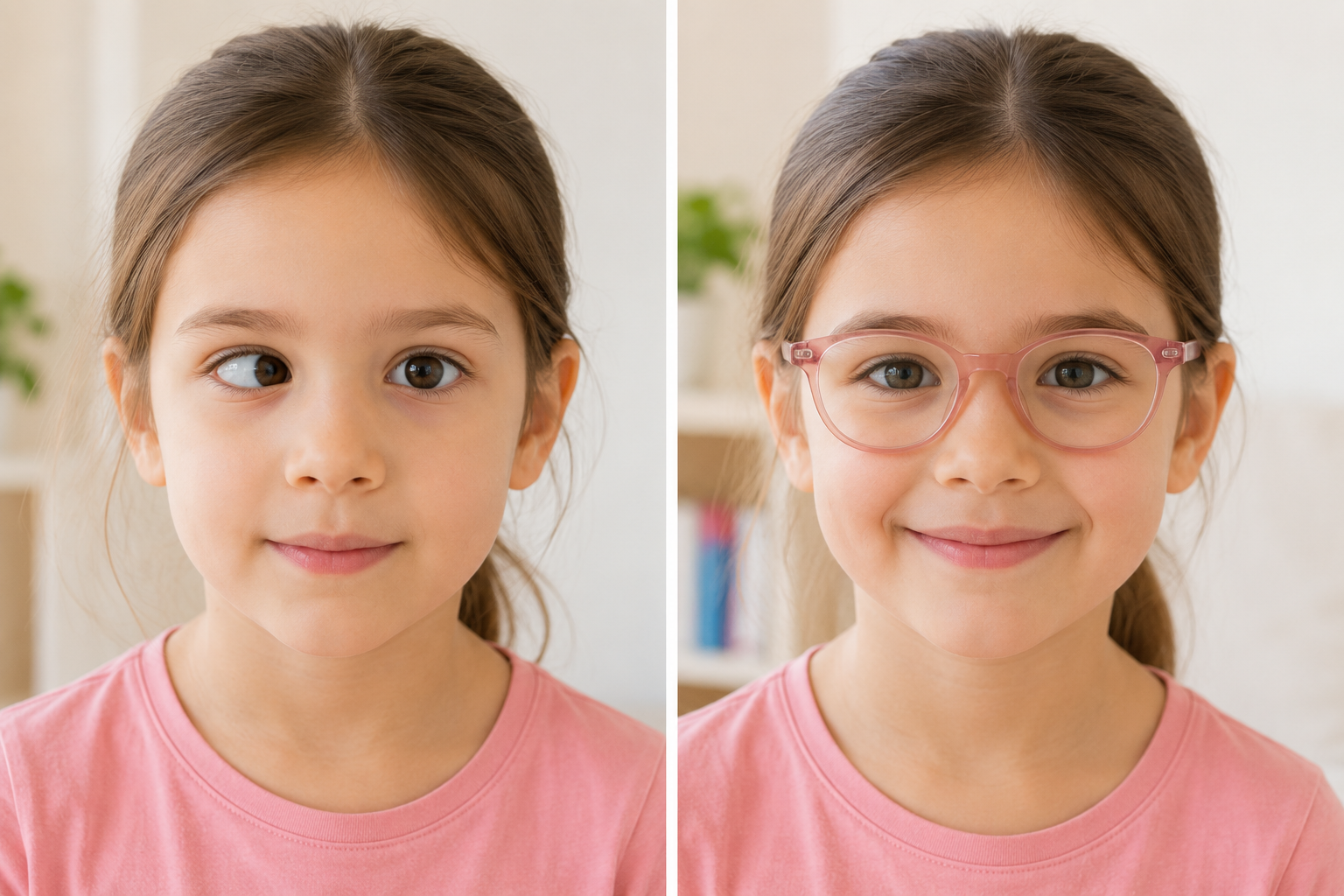
Accommodative esotropia is a common childhood squint in which one or both eyes turn inwards, particularly when focusing. It is usually linked to long-sightedness and most often appears between 6 months and 7 years of age, commonly around 2 to 3 years.
Why does the eye turn in?
Long-sighted children need to focus more strongly to see clearly. Because focusing and convergence are linked, this extra effort can pull one or both eyes inwards. Therefore, correcting the long-sightedness with glasses often improves the eye position.
Often linked to long-sightedness
Extra focusing effort can trigger the inward turn.
Usually starts in early childhood
Many children are diagnosed around two or three years of age.
Glasses are the main treatment
The correct prescription should usually be worn full time.
Amblyopia may also need treatment
Patching or atropine can improve reduced vision in one eye.
Two types of accommodative esotropia
The response to glasses helps distinguish the two main patterns. This difference is important because it guides whether glasses alone are sufficient or whether surgery may also be considered.
Alignment becomes straight in glasses
The inward squint is controlled when the correct long-sighted prescription is worn.
Some inward turn remains in glasses
Glasses correct the focusing-related part; however, a residual squint may remain and surgery may be considered.
Signs parents may notice
- One or both eyes turning inwards, especially when looking close up
- The squint becoming more obvious when tired
- Eye rubbing or frequent squinting
- Headaches or tired eyes
- Difficulty judging depth
- Occasionally an eye preference, suggesting reduced vision in the other eye
Double vision is unusual in younger children because the developing brain may suppress the image from the deviating eye.
How is it diagnosed?
First, an orthoptist measures vision in each eye and checks the eye alignment at distance and near. Next, dilating drops are used to relax focusing so that the full amount of long-sightedness can be measured accurately. Finally, Stephanie examines the eyes and explains whether the esotropia is fully or partially accommodative.
- Visual acuity in each eye
- Alignment with and without glasses
- Eye movements
- 3D vision where appropriate
- Cycloplegic refraction
The treatment pathway
Treatment is designed to improve alignment and support normal visual development. Although every child is different, the pathway commonly follows these steps.
Measure the full prescription
Dilating drops reveal the true amount of long-sightedness.
Wear glasses full time
Consistent wear reduces focusing effort and supports alignment.
Treat amblyopia if needed
Patching or atropine may be used if one eye has reduced vision.
Review residual squint
If a significant turn remains in glasses, surgery may be discussed.
Glasses
Glasses are the primary treatment. They reduce the focusing effort and, consequently, often improve alignment. They should generally be worn full time, including for near work and play.
It can take around six to eight weeks for a child to adapt fully to a new prescription and for the alignment response to be assessed properly. Therefore, consistent wear is essential during this period.
Patching or atropine
If amblyopia develops, the stronger eye may be patched or treated with atropine drops. This encourages the brain to use the weaker eye and improves visual development.
Importantly, patching treats reduced vision; it does not directly straighten the squint.
Squint surgery
In partially accommodative esotropia, a residual inward turn remains despite the correct glasses. In this situation, surgery may be recommended to improve the remaining misalignment.
However, surgery does not remove the need for glasses, and most children continue to wear their prescription afterwards.
Helping your child wear glasses
- Put the glasses on first thing in the morning
- Use simple praise and a consistent routine
- Ask the optician to check the fit if they slide or rub
- Keep a spare pair where practical
- Return for review if the eye turn changes noticeably
Even if the eyes appear straight in glasses, they may still turn in when the glasses are removed. This does not mean the glasses are making the eyes weaker.
Long-term outlook
Many children need glasses for several years and some continue into adulthood. Nevertheless, prescriptions can change over time and a small number of children become less dependent on glasses as they grow.
Regular review is important because vision, prescription and alignment all develop during childhood.
When should you contact us sooner?
- The inward turn becomes more frequent or more noticeable
- Your child stops wearing the glasses or says they cannot see clearly
- You notice a preference for one eye
- There are headaches, new double vision or a change in behaviour
- The eyes remain significantly misaligned in the correct glasses
A practical point
Bring your child’s current glasses to every appointment. In addition, photographs showing the eye turn with and without glasses can help demonstrate how the alignment behaves at home.
Will my child need squint surgery?
Glasses are always the first treatment for accommodative esotropia. They reduce the extra focusing effort caused by long-sightedness and, in many children, completely straighten the eyes.
If the eyes are straight while your child is wearing the correct glasses, squint surgery is not recommended. Operating on a fully accommodative squint could cause the eyes to drift outwards when the glasses are worn.
Some children have partially accommodative esotropia. In this situation, the glasses improve the alignment, but a residual inward deviation remains. It is only this residual deviation measured with the glasses on that may be suitable for surgery.
Squint surgery is therefore planned to improve alignment while the child continues to wear their glasses. The operation does not alter the underlying long-sightedness and does not usually remove the need for glasses.
Correct glasses worn
The full long-sighted prescription reduces focusing effort.
Alignment checked in glasses
We assess whether the eyes become straight or whether an inward turn remains.
Operate only on the residual deviation
Surgery is considered only when a meaningful inward squint remains with the correct glasses on.
What happens as my child gets older?
Many children continue to need glasses through adolescence and into adulthood, although the prescription may change as the eyes grow.
Later options can include contact lenses, which correct the long-sighted prescription without spectacle frames. For some adults, refractive surgery may also be considered to reduce dependence on glasses or contact lenses.
Suitability for refractive surgery depends on several factors, including the stability and size of the prescription, corneal health, age and the effect that changing the prescription may have on eye alignment.
Once your child reaches adulthood, Stephanie can assess their eye alignment and advise whether refractive surgery is likely to be suitable. She works closely with experienced refractive colleagues so that advice about vision correction and squint management is coordinated.
Important before refractive surgery
Laser or lens-based refractive surgery treats the glasses prescription rather than the eye muscles. Because accommodative esotropia is linked to focusing, changing the prescription can affect alignment.
Adults with a history of accommodative esotropia should therefore have a specialist squint assessment before proceeding with refractive surgery.
Can refractive surgery cure accommodative esotropia?
Not directly. Refractive surgery changes the focusing prescription; it does not reposition the eye muscles.
Reducing long-sightedness may lessen the accommodative component of the inward turn in some adults. However, any residual muscle imbalance may remain and occasionally needs separate squint treatment.
For this reason, Stephanie can assess the likely effect on alignment and liaise with refractive colleagues before treatment is planned.
Related children’s eye information
Lazy eye
Why amblyopia may accompany accommodative esotropia.
Glasses for children
Practical help with fit, wear and adjustment.
Squint surgery
Treatment for a residual inward squint.
Frequently asked questions
In fully accommodative esotropia, the eyes may become straight in the correct glasses. In partially accommodative esotropia, some inward turn remains.
Without the lenses, the child must focus harder again, and this extra focusing can trigger the inward turn.
No. Glasses reduce unnecessary focusing effort and support clear vision and eye alignment.
They are usually prescribed for full-time wear unless Stephanie gives different advice.
Many children need several weeks, and the full alignment response may take six to eight weeks to assess.
No. Patching treats amblyopia by improving vision in the weaker eye; it does not directly move the eye.
Surgery may be discussed when a significant residual squint remains despite the correct glasses.
Usually not. Surgery treats the remaining misalignment, while glasses continue to correct long-sightedness.
Some become less dependent on glasses as they grow, but many need long-term correction and regular review.
Yes. Older children may use contact lenses, and refractive surgery may be considered in adulthood in selected cases.
Concerned about an inward eye turn?
Arrange a specialist orthoptic and ophthalmic assessment for clear advice about glasses, amblyopia treatment and surgery.
Please contact your insurer before booking to confirm your cover and obtain any required authorisation.