Lazy Eye (Amblyopia) in Children
Amblyopia, often called a lazy eye, means that vision in one or occasionally both eyes has not developed normally during childhood. The eye itself may look completely normal, so screening and early assessment are extremely important.
Most treatment works best when children are young. However, older children may still benefit, particularly if they have never received treatment.
What is amblyopia?
Good vision develops when both eyes send clear, well-aligned images to the brain. If one image is consistently blurred, blocked or misaligned, the brain may favour the stronger eye and reduce its use of the other eye.
Over time, the visual pathway from the weaker eye does not develop normally. This is why amblyopia is more than a glasses problem and why simply waiting can lead to permanent reduced vision.
Clearer eye
Sends a sharp image
Weaker eye
Sends a blurred or misaligned image
Different prescriptions
One eye may be much more long-sighted, short-sighted or astigmatic than the other. This is called anisometropic amblyopia.
Squint
The brain may ignore the image from an eye that turns in or out to avoid visual confusion or double vision.
High prescription in both eyes
Both eyes can develop reduced vision if neither receives a clear image during early childhood.
Blocked vision
A cataract, droopy eyelid or other obstruction can prevent normal visual development.
More than one cause
Some children have a combination of squint and refractive error.
Amblyopia often has no obvious symptoms
A child may appear to see well because the stronger eye compensates. They may not complain, and the eyes can look straight and healthy.
- One eye turning in or out
- Closing or covering one eye
- Poor depth perception
- Difficulty with detailed visual tasks
- Unusual head position
- No visible signs at all
How is it assessed?
An orthoptist measures the vision in each eye separately using age-appropriate tests. Stephanie then assesses eye alignment, eye movements and eye health.
Dilating drops are usually required to relax focusing and accurately measure whether glasses are needed. The underlying cause must be identified before treatment begins.
Why school eye screening matters
The NHS recommends vision screening for children aged 4–5, usually in Reception. Its main purpose is to detect amblyopia and refractive errors before reduced vision becomes permanent.
Do not assume that screening has happened. Provision can vary, and not every independent or private school participates in the local NHS screening programme. Ask your child’s school directly.
Reception vision screening
Children are normally offered vision screening at age 4–5 to detect reduced vision that may otherwise have no symptoms.
Check that it is available
Not every independent school participates in the local NHS screening programme. Ask the school rather than assuming it has happened.
Arrange an eye test if needed
Book with a local optometrist experienced in testing children, or arrange a specialist appointment with us.
What should I do if my child is not screened?
Arrange an eye examination with a local optometrist who is confident testing young children, or book a specialist assessment with Stephanie and the orthoptic team.
A routine sight test should not be delayed because a child appears to see well. Children with one good eye can function normally while significant amblyopia remains undetected in the other eye.
Family history: consider assessment at age two
If a parent or sibling has had amblyopia, a squint, childhood patching or a significant glasses prescription, Stephanie recommends arranging an eye assessment at around two years of age.
This can be through a local NHS children’s eye service where available or privately with us. If you notice an eye turn, unusual pupil appearance, abnormal red reflex, poor visual behaviour or any other concern, seek referral sooner rather than waiting until age two.
Treatment for amblyopia
Treatment depends on the cause, the difference in vision, the child’s age and how the eyes work together. Glasses are normally prescribed first where needed, followed by patching or atropine if vision remains unequal.
Glasses
Give each eye the clearest possible image. Vision may improve with glasses alone.
Patching
Cover the stronger eye for the prescribed time so the weaker eye has to work.
Atropine
Blur near focus in the stronger eye as an alternative to patching in selected children.
Review
Measure progress, adjust treatment and monitor for recurrence or unwanted symptoms.
Glasses
Glasses give each eye the clearest possible image and treat long-sightedness, short-sightedness and astigmatism. Some children improve substantially with glasses alone, so a period of consistent full-time wear is often allowed before adding patching or atropine.
Glasses should be worn exactly as advised, even when no squint is visible.
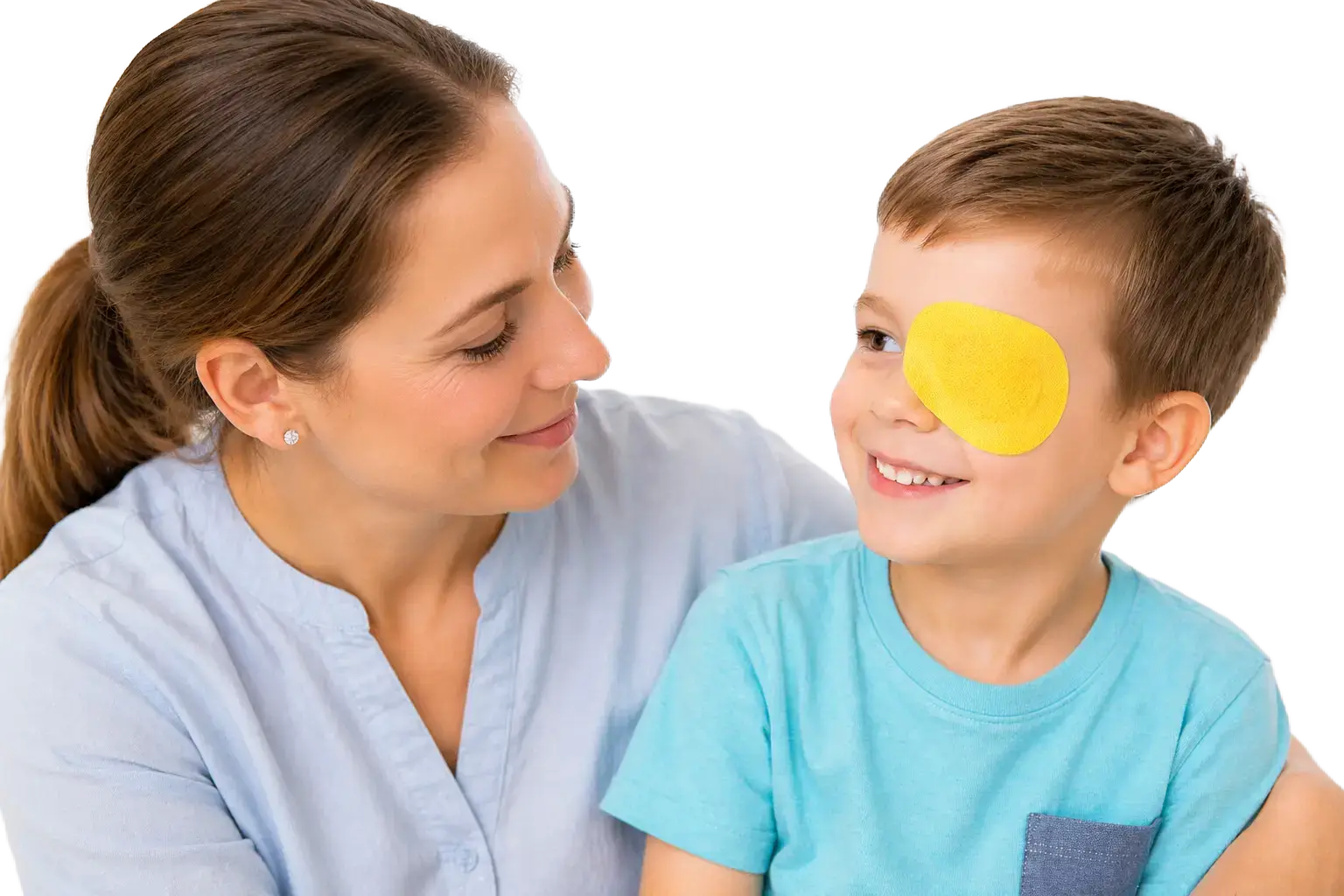
Patching
A patch is worn over the stronger eye for a prescribed number of hours. This encourages the brain to use the weaker eye.
The patch is usually placed directly on the skin beneath the glasses. Activities such as reading, colouring, puzzles or supervised tablet games can make patch time easier.
More patching is not automatically better. Follow the orthoptist’s instructions and attend reviews.
Atropine drops
Atropine can be used instead of patching in selected children. A drop in the stronger eye temporarily relaxes focusing and blurs near vision, encouraging use of the weaker eye.
The pupil also becomes larger and light sensitivity can occur. A sun hat and sunglasses can help outdoors. If your child normally wears glasses, prescription sunglasses are often particularly useful because they provide both their optical correction and protection from bright light.
Atropine must be used only as prescribed and stored safely out of children’s reach.
Making patching or atropine easier
- Use a predictable daily routine
- Let your child choose patch designs where possible
- Plan enjoyable close-up activities during treatment
- Use a reward chart for encouragement rather than punishment
- Tell school or nursery about treatment
- Use a hat or prescription sunglasses for atropine-related light sensitivity
- Contact the team if your child develops new double vision or significant symptoms
Apps and digital support
Apps such as Amblio or the Amblios Club have been designed to help families record patching time and encourage children during treatment. Other products, including binocular or game-based therapies, are also available.
These tools may improve motivation and adherence, but they should not replace prescribed glasses, patching, atropine or clinical review. Evidence and suitability vary, so discuss any digital treatment with your orthoptist before relying on it.
Can older children still be treated?
Yes. Treatment is generally most effective when started early, but research shows that children aged 7–12 can still improve with appropriate optical correction, patching or atropine. Some previously untreated teenagers may also respond.
If your child is 13 or under and has never received treatment, it may still be worthwhile arranging an assessment rather than assuming it is too late.
However, do not begin patching or atropine without a full assessment. The diagnosis must be confirmed, the underlying cause checked and binocular function assessed. In an older child with a longstanding squint, changing suppression can occasionally produce persistent and difficult-to-treat double vision. Treatment must therefore be individually supervised.
Important safety point
New double vision during treatment should be reported promptly. Treatment may need to be altered or paused while the eyes are reassessed.
The purpose of specialist review is to maximise potential visual improvement while protecting comfortable binocular vision.
Will treatment cure the squint?
Patching and atropine treat reduced vision; they do not directly straighten the eye. Glasses can improve some squints, particularly accommodative esotropia, while surgery may be considered separately for an eye misalignment that remains.
Why follow-up matters
Vision must be measured regularly to decide whether treatment should continue, increase, reduce or stop. Amblyopia can recur after apparently successful treatment, so follow-up may continue after patching or atropine has finished.
Related children’s eye information
Children’s squints
How eye misalignment can lead to reduced vision.
Accommodative esotropia
Why long-sightedness can cause an inward squint.
Children’s eye assessment
What to expect from an orthoptic and ophthalmic examination.
Frequently asked questions
No. Amblyopia means reduced visual development. A squint is an eye alignment problem, although a squint can cause amblyopia.
Yes. Anisometropic amblyopia often has no visible sign because the eyes appear straight.
Yes. Many children improve after consistent wear of the correct prescription before patching or atropine is added.
This depends on the severity and response to treatment. Follow the personalised schedule given by the orthoptist.
The patch should not hurt, although skin irritation and frustration can occur. The weaker vision may make tasks difficult initially.
Atropine can be an effective alternative in selected children. Suitability depends on the prescription, vision and clinical circumstances.
Atropine enlarges the pupil and can increase light sensitivity. Prescription sunglasses maintain clear corrected vision while making outdoor light more comfortable.
Yes. A child can function normally using one eye while significant amblyopia in the other eye remains unnoticed.
Not always. Ask the school whether it participates in the local NHS vision-screening programme and arrange an eye test if screening is unavailable.
Stephanie recommends assessment at around age two, or sooner if any concern is noticed.
No. Older children can still improve, although younger children generally respond more readily.
Potentially, yes. A full assessment is essential before treatment to confirm the diagnosis and evaluate binocular vision and the risk of troublesome double vision.
No. Apps may support adherence or provide prescribed activities, but they should not replace the treatment and monitoring recommended by the clinical team.
Yes. Recurrence can happen, particularly if treatment is stopped abruptly or follow-up is missed.
Concerned about your child’s vision?
A specialist assessment can identify amblyopia, establish its cause and explain whether glasses, patching or atropine may help.
Please contact your insurer before booking to confirm your cover and obtain any required authorisation.