Long-sightedness
Without enough focusing effort, light would come to a focus behind the retina. Children can often compensate by focusing strongly, which is why they may still appear to see well.
STEPHANIE WEST CONSULTANT OPHTHALMIC SURGEON
Specialist squint, double vision and children’s eye care in Southampton
Being told that your child needs glasses can raise lots of questions—especially if they seem to manage perfectly well without them.
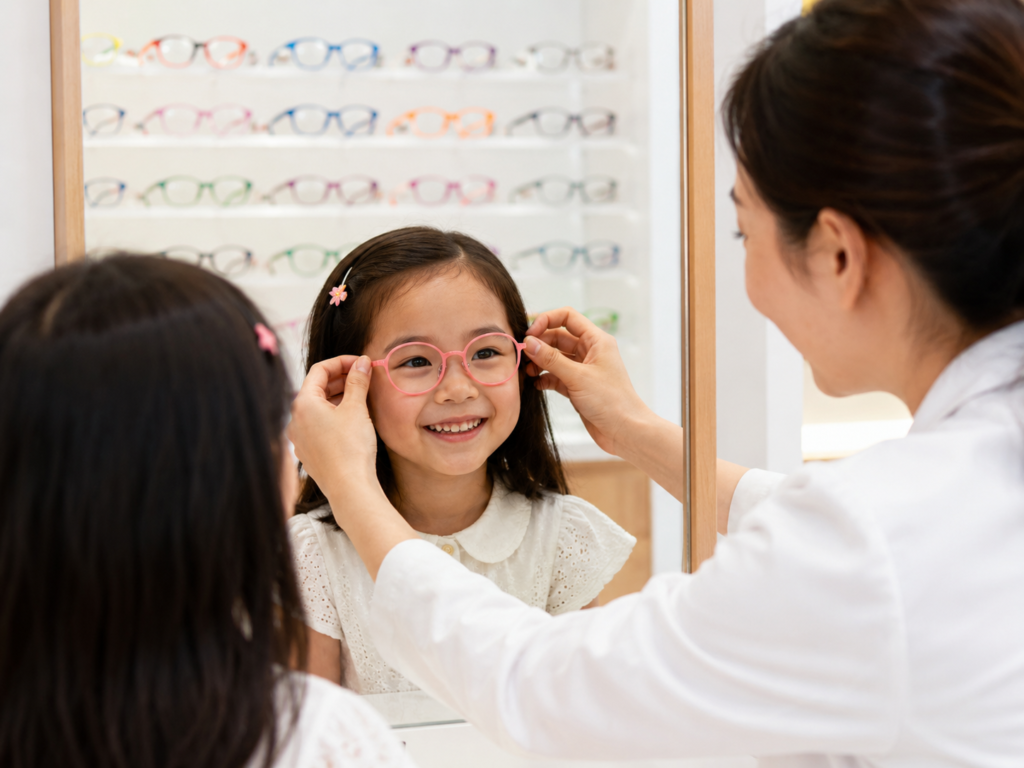
Children’s glasses are prescribed to give clearer, more comfortable vision and, importantly, to support normal visual development. They may also help a squint, reduce the risk of amblyopia (a “lazy eye”) or make it easier for your child to learn and play.
The reason is not always simply “they cannot see”. We prescribe glasses when the expected benefit is greater than leaving the eyes to compensate.
Glasses bring the image into focus so your child can see detail more easily at distance, near or both.
A clear image in each eye helps the brain learn to use both eyes during the important early years.
In some children—especially those who are long-sighted—glasses reduce the focusing effort that can make an eye turn in.
This is one of the most common questions parents ask. A child may appear to see well without glasses for several reasons:
Being able to navigate a room or recognise a parent does not tell us how clearly each eye sees or how hard the child is working to focus.
Glasses are not prescribed only because a child fails to cope. They are prescribed to give the eyes and brain the best-quality image during development—before a problem becomes obvious.
These animated diagrams show where light focuses in the eye and how glasses help correct each type of prescription.
Without enough focusing effort, light would come to a focus behind the retina. Children can often compensate by focusing strongly, which is why they may still appear to see well.
Light focuses before it reaches the retina. This makes distance detail blurred, although close objects may remain clear.
The eye has different focusing power in different directions, so light does not form one sharp focus. This may blur or distort vision at both distance and near.
One eye may be more long-sighted, short-sighted or astigmatic than the other. The clearer eye can mask reduced vision in the eye with the larger prescription.
Astigmatism is sometimes described as the eye being shaped more like a rugby ball than a football. This is only an analogy—the eye can look completely normal from the outside.
It is not caused by reading, screens or wearing glasses. A child with astigmatism may screw up their eyes, sit closer, confuse fine detail or have no obvious symptoms at all. The first pair of glasses can make the world look unusually sharp or slightly stretched for a few days; regular wear usually helps the brain adapt.
Measuring a child’s prescription is different from testing an adult because children can use their focusing muscles to temporarily overcome blur. The method we use depends on their age, cooperation and the reason for the glasses.
Children can focus very strongly, sometimes hiding part of a long-sighted prescription. Cycloplegic eye drops temporarily relax the focusing muscles so we can measure the underlying prescription accurately.
As children become older and can reliably compare lenses, the prescription can be refined by asking which choice gives the clearest and most comfortable vision.
Often recommended when the prescription is needed throughout the day, when one eye is weaker, or when glasses help control a squint.
Sometimes suitable for mild myopia or a specific distance task. Follow the individual instructions given for your child.
Put glasses on after getting dressed, keep the case in the same place and ask school or nursery to support the plan.
Please follow the wear instructions given at your child’s appointment. The same prescription can be used for different reasons, so advice that is right for another child may not be right for yours.
The best children’s glasses are the pair that fits well, gives a clear view through the centre of the lenses and feels comfortable enough to stay on.
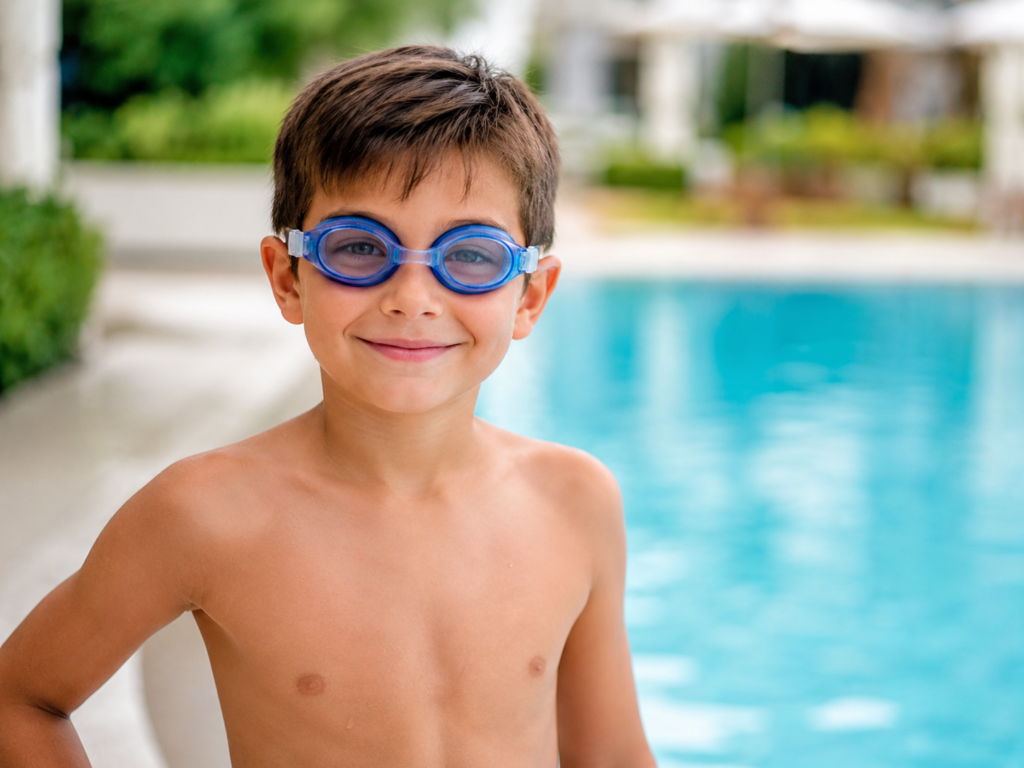
Prescription swimming goggles are available. Some use ready-made lens powers and others can be made more precisely. They are particularly helpful for children with stronger prescriptions who otherwise struggle to see poolside instructions, lane markings or family members.
For contact sports, ask about prescription sports goggles or protective eyewear that meets the relevant safety standard. Ordinary frames are not designed for every sport.
A spare pair is sensible when glasses are needed full time. Prescription sunglasses can also be useful, particularly for children who are light-sensitive or using atropine drops. These extra pairs are usually purchased privately.
Children’s eyes grow and their focusing system develops, so prescriptions are not expected to remain identical forever. The pattern varies between children and cannot be predicted perfectly from a single examination.
In England, children under 16—and young people aged 16, 17 or 18 in qualifying full-time education—are generally eligible for a free NHS sight test and help towards the cost of glasses or contact lenses.
Children are usually entitled to help with the cost of glasses through the NHS. However, an NHS GOS3 optical voucher must be issued through an NHS General Ophthalmic Services sight test or an eligible NHS hospital eye service. A private consultation with Stephanie West is not an NHS GOS sight test, and our private clinic is not commissioned to issue or process GOS3 vouchers.
We can provide your child’s written prescription and clinical findings. You can take these to your chosen dispensing optician. To use an NHS voucher, the optician may need to carry out or arrange the appropriate NHS sight-test process and confirm eligibility. The voucher is a contribution based on the prescription and may not cover the full cost of every frame or lens option.
Practical next step: Before ordering glasses, tell your chosen optician that the prescription came from a private ophthalmology appointment and ask how they handle NHS eligibility and vouchers. This avoids unexpected costs.
We can explain the prescription, whether it should be worn full time, how it relates to a squint or amblyopia, and when your child should be reviewed.
Please contact your insurer before booking to confirm your cover and obtain any required authorisation.