STEPHANIE WEST CONSULTANT OPHTHALMIC SURGEON
Specialist squint, double vision and children’s eye care in Southampton
Double Vision After Cataract Surgery
Seeing double after cataract surgery can be worrying, but the cause can usually be identified and effective treatment is often available.
Cataract surgery does not usually damage the eye muscles. More often, clearer vision or a major change in spectacle prescription reveals an eye alignment problem that was previously hidden or well controlled.

Why can double vision appear after cataract surgery?
For most patients, cataract surgery improves vision without affecting eye alignment. In a small number of people, however, the operation changes the visual balance between the two eyes. A cataract may previously have reduced the vision in one eye, strong glasses may have altered the optical demands at near, or a congenital deviation may have been controlled by the brain for many years.
Once the cataract is removed, these compensating mechanisms can change. The result may be new horizontal, vertical or near double vision.
Common reasons
A hidden squint becomes apparent
A dense cataract may reduce one eye’s contribution to binocular vision. When vision improves after surgery, a pre-existing tendency for the eyes to drift can become noticeable.
A congenital deviation decompensates
Longstanding conditions such as a congenital fourth nerve palsy or childhood squint may have been compensated for throughout life. After surgery, the brain may no longer maintain comfortable fusion.
Strong myopic glasses are removed
High-powered minus lenses provide a base-in prism effect when looking through them at near. After cataract surgery, losing that optical assistance can uncover convergence insufficiency and near diplopia.
The focusing balance changes
A large alteration in prescription can change the relationship between accommodation and convergence, particularly in people with long-sightedness, anisometropia or previous prism correction.
Suppression is no longer effective
Sharper, more equal images from the two eyes may make previously intermittent or ignored double vision much more noticeable.
Another eye movement disorder is present
Less commonly, thyroid eye disease, cranial nerve palsy, myasthenia, previous trauma or retinal surgery may be responsible and require targeted assessment.
Previous high myopia and near double vision
One particularly important and often overlooked cause affects people who wore strong short-sighted glasses before cataract surgery.
When a person reads through strong minus lenses, the lenses create a base-in prism effect. This reduces the amount of convergence the eyes need to generate at near. Following cataract surgery, the strong glasses may no longer be needed, so this optical assistance disappears.
If the convergence system is weak, the patient may then notice double vision when reading, using a phone or working at a computer. Cataract surgery has not weakened the muscles; it has uncovered a pre-existing convergence problem.
- Double vision mainly for reading or screen work
- Eye strain or headaches at near
- Symptoms improve when one eye is closed
- Prism glasses or targeted treatment may help
A congenital deviation may have been compensated for decades
Cataract surgery can reveal a longstanding vertical deviation, such as a congenital fourth nerve palsy, when fusion can no longer compensate.
Uncovering a congenital fourth nerve palsy
A congenital fourth nerve palsy can remain symptom-free for many years because the brain has strong vertical fusion and the person may subtly tilt their head to keep the images aligned.
After cataract surgery, a change in image clarity, size or spectacle correction can exceed that compensating ability. Vertical or diagonal double vision may then appear, despite the underlying deviation having been present since childhood.
Clues can include an old head tilt in photographs, facial asymmetry, a longstanding preference for one head position, and unusually large vertical fusional reserves.
How I assess double vision after cataract surgery
Finding the underlying diagnosis is the key to choosing the right treatment. Your assessment may include:
- A detailed history of the cataract surgery and when symptoms began
- Review of previous glasses, prism use, childhood squint or patching
- Measurement of the eye alignment at distance and near
- Assessment in different directions of gaze and head positions
- Binocular vision, fusion and convergence testing
- Checking whether temporary prisms relieve the symptoms
- Further investigation if a neurological, orbital or muscle disorder is suspected
Treatment options
Treatment depends on the pattern of double vision, the underlying cause and whether the measurements are stable.
Observation
Some patients improve over several weeks or months as the visual system adapts and the postoperative prescription stabilises.
Prism glasses
Temporary Fresnel prisms or permanent prisms can often restore comfortable single vision without an operation.
Exercises
Selected patients with convergence insufficiency may benefit from carefully prescribed convergence exercises.
Botulinum toxin
Botulinum toxin can be useful in selected cases, particularly while the deviation is changing or as a diagnostic treatment.
Squint surgery
When measurements are stable and symptoms persist, tailored eye muscle surgery may provide a long-term solution.
Frequently asked questions
Usually not. In most patients, surgery has revealed an underlying alignment problem or altered the optical balance between the eyes.
Sometimes. Improvement can occur as the visual system adapts and the postoperative prescription stabilises, but persistent symptoms should be assessed.
Yes. Removing strong minus lenses also removes their helpful base-in prism effect at near, which may uncover convergence insufficiency.
Yes. A congenital or childhood deviation may remain compensated for decades and become symptomatic after a change in vision or spectacle correction.
Not necessarily. Observation, prisms or targeted exercises may be sufficient. Surgery is considered when symptoms persist and the deviation is suitable and stable.
When should you seek urgent advice?
Seek urgent medical assessment if sudden double vision is accompanied by a severe headache, new drooping eyelid, unequal pupils, weakness, numbness, speech difficulty or other neurological symptoms.
Specialist squint care — easier to reach than you may think
Patients travel to Southampton from across the UK and overseas for specialist assessment and treatment of adult squint, double vision, complex eye movement problems and previous squint surgery. A video consultation can often be arranged first, helping us review your history and plan the most useful next steps before you travel.
Start with a video consultation
Your first appointment may be held by secure video. This is particularly helpful for patients travelling a long distance or coming from overseas.
Before the consultation, you can share previous clinic letters, orthoptic measurements, glasses or prism prescriptions, scan reports and earlier squint surgery records. This helps us understand your condition and decide what assessment or treatment may be appropriate.
Straightforward UK travel
Southampton has direct rail services from London Waterloo and good connections from across southern England, the Midlands, Wales and the South West.
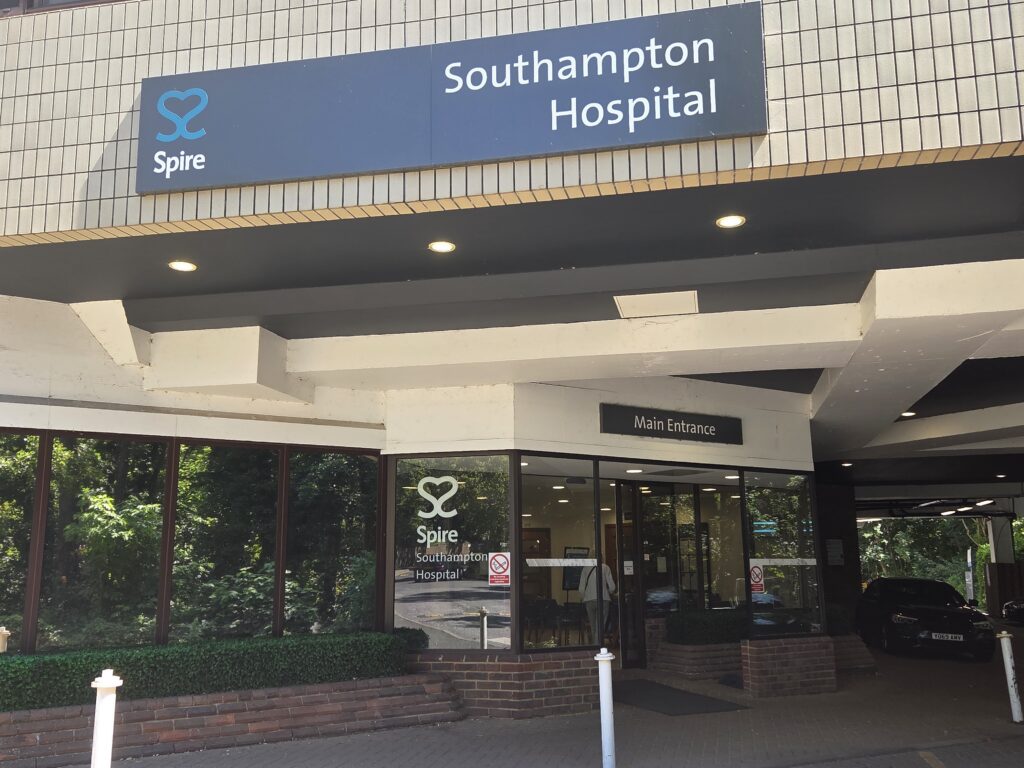
Spire Southampton Hospital is approximately a 10-minute taxi journey from Southampton Central station. It is also easily reached by road using the M3 and M27, with on-site patient parking.
International patients welcome
Southampton International Airport is approximately 15 minutes by taxi from the hospital and is immediately beside Southampton Airport Parkway railway station.
Patients arriving through Heathrow or Gatwick can continue to Southampton by rail, coach or car. Appointments can be coordinated wherever possible to reduce unnecessary journeys and make the visit as efficient as possible.
Travelling a long distance?
Contact us before booking travel. We can advise whether a video consultation would be useful first and which medical records or measurements to send securely for review.



Persistent double vision deserves specialist assessment
I regularly assess adults who develop double vision after cataract or lens surgery. I will explain the likely cause, whether improvement is expected, and the most appropriate treatment options for you.
Please contact your insurer before booking to confirm your cover and obtain any required authorisation.